


Mandarin Oriental today made its debut in Austria with the opening of Mandarin Oriental, Vienna.
Set on a quiet street in Vienna’s prestigious First District, the hotel is located within the historic Ringstrasse — a UNESCO World Heritage Site known for its architectural grandeur and timeless elegance.
Mandarin Oriental, Vienna is housed in an early 20th century, Art Nouveau building by Austrian architect Alfred Keller, which originally served as a courthouse. The interior design studio Goddard Littlefair led the building’s transformation into a luxury hotel.
Spanning four floors, the hotel’s 86 rooms and 52 suites feature abundant natural light, bespoke furnishings, soft neutral color palettes, Secessionist-inspired fabrics and thoughtfully designed bathrooms.
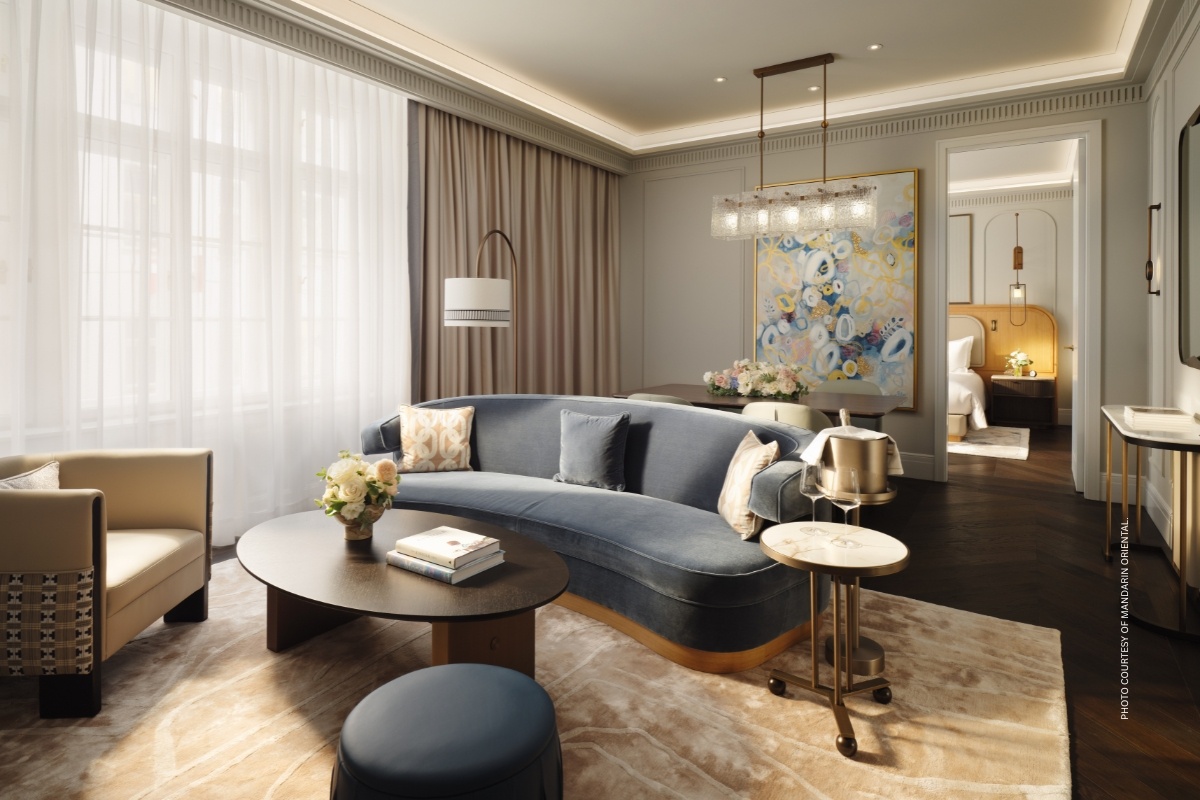
Photos of premier suite and reception area (top of post) are courtesy of Mandarin Oriental.
The property’s dining experiences are helmed by Chef Thomas Seifried. The four dining venues are: Le Sept (fine-dining, seafood); Atelier 7 – Brasserie (all-day dining); Atelier 7 – The Café (patisserie and specialty coffee); and Atelier 7 – Izakaya & Bar (Japanese).
Mandarin Oriental, Vienna also features:
- a restored courtyard
- arrival spaces showcasing sculptural chandeliers and the original grand staircase
- a spa with seven treatment rooms and a luxurious relaxation area
- an indoor pool
- a fully-equipped fitness center
The hotel also offers seven multifunctional meeting and event spaces, ranging from a 12-person boardroom to an elegant 1,500+-square-foot ballroom. All spaces feature natural light, elegant decor, and state-of-the-art technology.
At the heart of this new landmark stands the emblematic Mandarin Oriental, Vienna fan reimagined by celebrated Austrian artist Peter Jellitsch as an artistic statement that embodies both the spirit of Vienna and the brand’s Asian heritage. Expressive brushstrokes sweep across a precise geometric grid, capturing the dynamic balance between movement and stillness, spontaneity and structure. Drawing inspiration from Vienna’s artistic lineage, Jellitsch infuses the design with influences from Art Nouveau and his signature visual language. The fan’s chequerboard motif evokes order and architectural form, while fluid gestures of color convey emotion and vitality. The artwork is a symbol of where the city’s centuries-old craftsmanship meets its forward-looking creativity.





 Powered by